Part 9 of 26
Reading lessons
Every reading lesson, Pre-K to Grade 5, is a picture book: big numbered sections, a drawing on each page, and the words in large type. Key words are marked like a highlighter pen. There are two kinds of book. A story lesson is built around a real story or article, read with a reading buddy beside your child. A skill lesson teaches letters, sounds, word parts, sight words or writing.
Each story page has a Listen to all button that reads the page aloud and lights each word as it goes. Headings, words, questions and the buddy’s lines each have a small speaker button of their own; a question’s speaker reads its answer choices too. Reading lessons have no videos.
A story lesson
A story lesson has four parts, or five from Grade 3. The bar at the top and the This lesson list work as they do in math. See Inside a lesson.
1. Get Ready
One line saying why we are reading today. Not “read this story”, but something your child can carry with them, such as a story has three parts, and you will find them by asking what happens to the problem. Under it are the cover, with the title, and Words to know: a few words from the story, each with what it means. The same words are marked wherever the story uses them. Some lessons also ask for a guess here, before the story starts; the story answers it later.
Read to me is a switch: on to begin with in Pre-K and Kindergarten, off from Grade 1. Turned on, each page is read aloud as it opens. It is for a child still sounding words out; a child who reads well reads faster without it. It stays on for that device until it is turned off.
2. Read and Answer
The story arrives a page at a time, marked Page 1 of 3 and so on. Pages still ahead are on screen but dimmed, and their drawings stay hidden, because a drawing could show what your child is about to guess. After each page the reading buddy, a round face with a speech bubble, says what they noticed, and then there is one question in a yellow box.
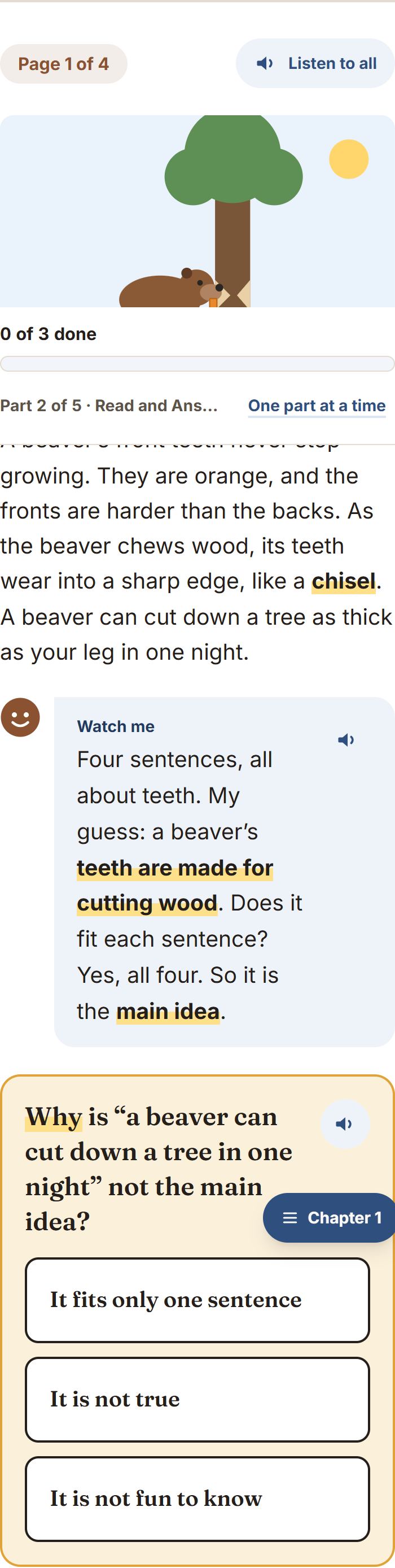
- Watch me. On the first page the buddy does the noticing, so your child sees what it looks like before being asked for any of it.
- Let’s do it together. On the next page the buddy starts the thought and your child finishes it with one tap.
- Your turn! On the last page the question comes with no help.
The question is a choice, a guess about what happens next, or Tap the sentence in the story.
3. Read It All
Once every question is answered, the whole story appears again, clean and large, with its drawings. Until then the section says Answer all the questions to open the whole story. Any guess made on the way is settled here by the reading buddy. This second read is the point rather than a reward: reading something again for a different reason is the best-evidenced thing anybody does with a text.

4. My Notebook, from Grade 3
From Grade 3 there is one more section: two things your child noticed, typed and kept on the device. Where the prompt asks for words from the story, the entry has two halves: the words, then what your child noticed about them. The app looks the words up in the story and says Found it when they are there. It never marks what your child noticed.
After writing, See what a reader noticed shows two example entries and a few questions to ask of their own. It comes after on purpose: an example read first gets copied. The notebook does not count toward finishing the lesson. It appears on your family page.
5. What You Learned
The idea in a few lines. Some lessons add a tip, and a folded For the grown-up box with notes for you.
A skill lesson
Letters, sounds, blending, sight words, word parts and writing, mostly in Pre-K to Grade 2. These lessons have their own book shape:
- Get Ready: what today is about, and words to know.
- Learn It: the teaching a page at a time. A heading, a drawing or big word cards with the part that matters marked, and sometimes something to touch, such as letters to trace or sounds to blend.
- Try It: things to play with, when the lesson has them.
- Your Turn: the questions, each in a yellow box.
- What You Learned.
One text, read several times
A story chapter is built on one text rather than four. Grade 2’s chapter on how stories are built reads the same story four times: for its three parts, for the problem that causes everything, for who is telling it, and finally beside a second story to compare it with.
That is on purpose. The second reading of anything is done by somebody who already knows how it ends, and it finds things the first cannot. By the fourth lesson the words are familiar, which frees your child’s attention for the thinking. The Grade 3 to Grade 5 stories are written at their own grade’s reading level.
What counts as finishing
The questions. Reading the story again at the end cannot be checked, and the notebook is your child’s own, so neither fills the bar. A child who has answered every question has done the lesson.
Chapter checks
A reading chapter check asks about short passages your child has not seen before, rather than about the story from the lessons. That measures reading rather than memory. It works like every other chapter check. See Chapter checks.
What next
Worksheets and printing covers the practice sheets. Every reading lesson has a set, built from the lesson’s own text and questions.